

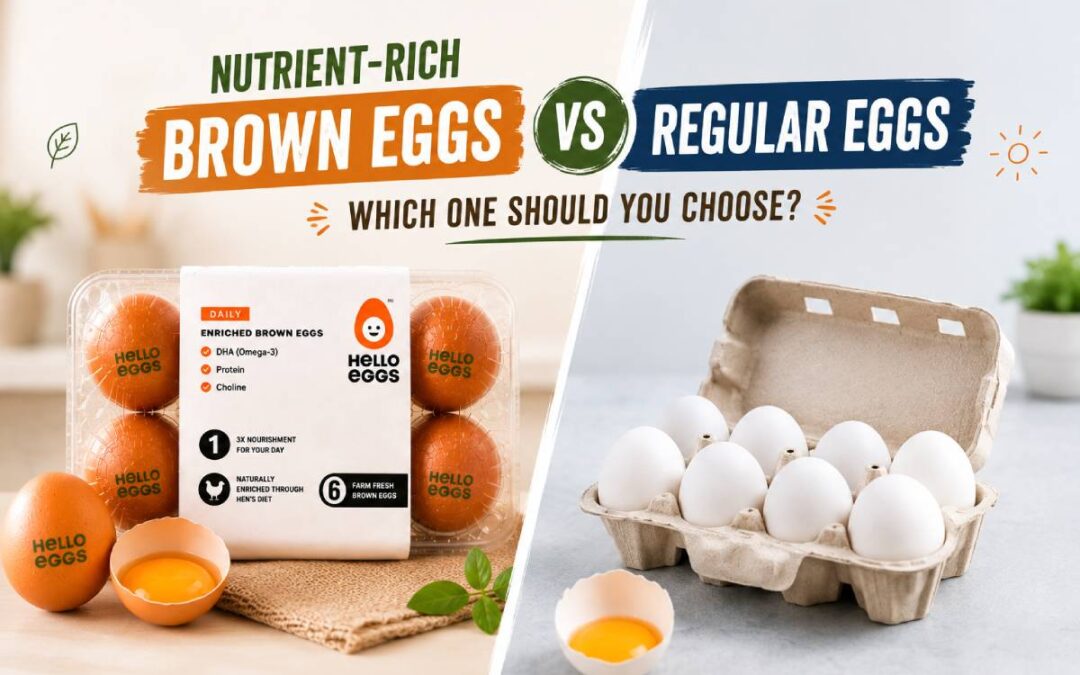
Stand in front of any egg shelf and you’ll see the same quiet assumption at work: shoppers reaching for brown eggs because they look healthier, more natural, more “desi.” Nutrient-rich brown eggs command a premium in nearly every Indian store. But is the brown shell actually the reason for the nutrition? The honest answer is more interesting – and more useful – than a simple yes or no.
What Actually Makes an Egg Brown?
Shell colour is decided by the breed of the hen, nothing more. Hens with certain genetics lay brown-shelled eggs; others lay white. The shell pigment is added in the last hours before the egg is laid and doesn’t penetrate inside. So if you took two hens – one brown-egg breed, one white-egg breed – and fed them identical diets in identical conditions, the eggs inside would be nutritionally near-identical.
So Where Do Nutrient-Rich Brown Eggs Come From?
Here’s the part the shelf doesn’t tell you: an egg’s nutrition is written by the hen’s feed, health, and living conditions – not the shell. Genuinely nutrient-rich brown eggs come from hens that are well-bred, well-fed, and well-cared-for. A brown egg from a stressed, poorly fed hen is nutritionally ordinary. A brown egg from a hen on scientifically formulated feed can carry meaningfully more of specific nutrients – DHA omega-3, vitamin D3, better protein quality.
In other words, brown eggs earned their healthy reputation partly by association: many premium and free-range producers happen to use brown-egg breeds. The colour became a shorthand for care. The care, not the colour, is what you’re actually paying for.
The Right Question: How Was the Hen Fed?
This is the lens worth carrying to the shelf. Instead of asking “brown or white?”, ask what the brand can tell you about the journey behind the egg. At Hello Eggs, that journey is unusually transparent because parent company Srinivasa Farms controls all of it – its own genetics, its own feed mills and soya processing, in-house veterinary teams, and laboratory testing at every stage, a system built over 60 years. The hens’ feed is formulated by poultry nutritionists to naturally enrich the eggs with nutrients like vitamin D3, vitamin E and selenium – enrichment that happens through the hen’s diet, not anything added afterwards. That’s what makes an egg measurably richer in nutrients – whatever colour its shell happens to be.
Nutrient-Rich Brown Eggs: A Fair Comparison Checklist
When you’re comparing nutrient-rich brown eggs against loose regular eggs, run through five things. One: enrichment – does the pack state specific added nutrients like DHA or D3, and how they got there? Two: grading – Grade AA indicates firmer whites, well-centred yolks, and clean shells. Three: hygiene – loose eggs pass through many hands; look for UV sanitized, packaged eggs. Four: freshness – a short, controlled farm-to-shelf chain beats a week in transit. Five: clean rearing – no antibiotics, and vegetarian feed if that matters to your household, as it does for many Indian families.
Notice that shell colour didn’t make the list. Every factor that genuinely separates a premium egg from a commodity egg is invisible from the outside – which is exactly why buying branded, labelled eggs matters. The label is where the invisible becomes verifiable.
So Which Should You Choose?
Choose the egg with the better story behind it, told in specifics. If the nutrient-rich brown eggs on the shelf come with stated enrichment, grading, sanitization, and a traceable source, they’re worth the premium – because of everything behind the shell. If they’re simply loose brown eggs at a higher price, you’re paying for pigment.
Eggs are one of the few foods most Indian families eat almost daily. That daily repetition is precisely what makes the choice matter: a small nutritional difference, multiplied by 365 mornings, becomes a real one. Pick for the hen’s diet, not the shell’s colour – your breakfast will be smarter for it.